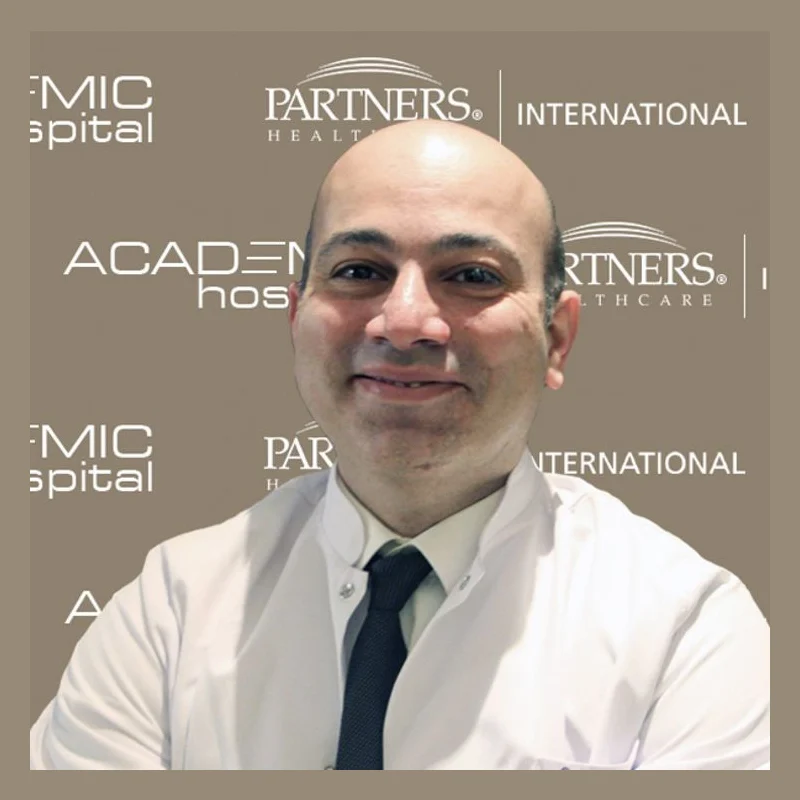
Dr. Öğr. Üyesi Görkem Kıyak
OrthopedicsVerified
- 21+years exp.
English · Turkish
FromPrice on request
Free quote
60 seconds · no obligationView Profile
What a Bankart repair is, how a torn shoulder labrum is reattached with suture anchors after a dislocation, what the evidence says about recurrence in young active people, how it compares with physiotherapy, open repair and the Latarjet operation, approximate costs in Turkey against the UK, US and Germany, recovery and risks.
A written plan with the surgeon's name and the full price — usually within 24 hours.

1 doctor Compare doctors, ratings and prices — ask any of them for a free quote.
OrthopedicsVerified
English · Turkish
60 seconds · no obligationView Profile
A Bankart repair is a shoulder operation that reattaches the torn front-lower edge of the shoulder socket's rim, called the labrum, to the bone. The shoulder is a ball-and-socket joint with a very shallow socket, and the labrum is a ring of cartilage that deepens it. When the shoulder dislocates forwards, the labrum is often torn off the front of the socket (the "Bankart lesion"), and the ligaments that normally hold the ball in place are stretched with it. The shoulder then slips out again with little force. In the operation the surgeon passes small suture anchors into the socket and uses their threads to pull the labrum and capsule back into position, which restores the bumper and tightens the joint. Orthopaedic departments in Turkey do most Bankart repairs through keyhole surgery as part of orthopedics treatments in Turkey.
This guide explains who needs the operation, what the evidence says, what it costs compared with the UK, US and Germany, how the operation and recovery work and how to check a clinic.
Typical features are one or more full dislocations (where the arm had to be put back by a medic), or repeated partial slips (subluxations) when the arm is raised and turned outwards, as in throwing, a tackle or reaching overhead. Between episodes the shoulder may feel apprehensive, weak or "loose". An MRI arthrogram, in which contrast is injected into the joint, shows the labral tear, and a CT scan or X-rays show whether the ball or socket has lost bone. Bone loss matters, because a large defect changes which operation is advised. Not every unstable shoulder has a Bankart lesion; loose-jointed people may have a different problem that needs other treatment.
Yes, for the right patient. Studies show that people under about 25 who play contact or overhead sport and have dislocated once have a high chance of dislocating again if treated with physiotherapy alone, and that stabilisation surgery lowers this risk considerably. Arthroscopic Bankart repair now produces results comparable to open repair in patients without major bone loss. It is less reliable when the socket or ball has lost a lot of bone, when the capsule is very loose or when the patient dislocates during sleep; in these situations surgeons may add extra procedures or choose a bone-transfer operation. The honest figure for any individual depends on age, sport, the number of earlier dislocations and bone loss, which is why a scan and a clear explanation matter more than an offered percentage.
The figures below are approximate ranges, not hospital quotes. The price depends on whether the repair is arthroscopic or open, the number of anchors, whether extra procedures are added, the type of anaesthesia and the number of nights in hospital. Each hospital confirms its price in a written quote.
| Country | Approximate cost range |
|---|---|
| Turkey | €3,000 – €7,500 |
| United Kingdom | €6,500 – €13,000 |
| United States | €12,000 – €40,000 |
| Germany | €6,000 – €12,500 |
A package normally includes the consultation and MRI review, the operation, anaesthetist, one or two nights in hospital, anchors and sutures, a sling and medication, and often transfers. Ask whether physiotherapy sessions in Turkey are included and whether the price changes if the surgeon finds more damage than the scan showed.
| Option | Suited to | Typical limits |
|---|---|---|
| Physiotherapy only | First dislocation, older or low-demand patients, no major bone loss | Higher chance of another dislocation in young sport players |
| Arthroscopic Bankart repair | Labral tear with little or no bone loss; keyhole surgery | Less reliable with large bone loss or very loose capsule |
| Open Bankart repair | Revision cases, extra capsule tightening needed | Larger cut; slightly longer recovery |
| Latarjet (bone transfer) | Significant socket bone loss or failed earlier repair | Bigger operation with its own nerve and screw risks |
The choice rests on what the scan shows and what you need from the shoulder. The same keyhole principle is used elsewhere in orthopaedics; for a knee example, see arthroscopic meniscus repair.
Good candidates are adults with recurrent anterior dislocations or instability that limits work or sport, confirmed on scan, and who are willing to follow a structured rehabilitation. You are less suited if the main problem is multidirectional looseness in a hypermobile shoulder, if there is large bone loss that needs a different operation, if you have an active infection, or if you cannot commit to the sling and physiotherapy period. Smokers heal more slowly. A surgeon should tell you at the consultation if another operation is more appropriate.
The operation takes about 60 to 90 minutes, and most patients go home or to the hotel the same day or after one night.
Recovery is long, because the repair must heal to bone before it is loaded.
| Time after surgery | Typical milestone |
|---|---|
| Weeks 0–3 | Sling day and night; hand, wrist and elbow movement; gentle pendulum exercises |
| Weeks 3–6 | Sling weaned; guided passive movement, avoiding outward rotation limits set by the surgeon |
| Weeks 6–12 | Active movement and gentle strengthening; desk work and light driving usually possible |
| Months 3–4 | Progressive strengthening; sport-specific drills without contact |
| Months 4–6 | Return to contact or overhead sport if strength, movement and control are adequate |
The timings are typical, and your surgeon may change them. Skipping rehabilitation is a common reason for a poor result.
Plan about three to five nights: consultation and scan review, surgery, a night in hospital and a check of the wound and sling fit before the flight. The first rehabilitation sessions are often given before you leave, and a physiotherapist at home continues the programme from the protocol the hospital provides. Flying is usually fine after a few days; carry the sling, use a seat that gives the arm room and avoid lifting luggage. Because most of the recovery takes place at home, ask for the written protocol and the surgeon's contact details.
Possible risks include stiffness, particularly loss of outward rotation; recurrent dislocation or instability, more likely in young contact-sport players and in people with bone loss; nerve irritation from the nerve block or the operation; infection; problems with anchors or sutures; and the general risks of anaesthesia. Some people develop shoulder arthritis many years after repeated dislocations, whether or not they have surgery. The NHS, the British Elbow and Shoulder Society and the American Academy of Orthopaedic Surgeons describe stabilisation surgery as a considered decision that depends on age, activity and scan findings. Report fever, increasing pain, wound redness or numbness in the hand quickly.
Look for an orthopaedic surgeon who performs shoulder arthroscopy regularly, a hospital with arthroscopy equipment, an anaesthetist and physiotherapy, and a written plan that states the technique and expected rehabilitation. Red flags include a quote without seeing your MRI or CT, a promise that the shoulder will never dislocate again, no discussion of bone loss and alternatives, and no plan for physiotherapy at home. Read how our process works and request a written plan through our free quote page.
Questions to ask the clinic:
It is a shoulder operation that reattaches a torn labrum, the cartilage rim at the front of the socket, using small suture anchors. It restores the socket's depth and tightens the joint after a forward dislocation.
For people with recurrent dislocations and little bone loss, it lowers the risk of further dislocation considerably, especially in young sport players. Results are less reliable with large bone loss or very loose joints.
Approximate ranges are €3,000 to €7,500 in Turkey, against about €6,500 to €13,000 in the UK. The price depends on the technique, the number of anchors, the anaesthesia and the nights in hospital.
The sling is worn for about three to six weeks, desk work often resumes around six to twelve weeks, and return to contact or overhead sport usually takes four to six months.
A nerve block numbs the shoulder at first. Afterwards pain is moderate for several days to two weeks and is controlled with painkillers, ice and the sling.
Arthroscopic Bankart suits a labral tear with little bone loss. The Latarjet transfers bone and is advised when the socket has lost a significant amount of bone or an earlier repair failed. A scan decides.
Yes, it can, particularly in young contact-sport players or when there is bone loss. Following the rehabilitation protocol and having an accurate diagnosis reduces the chance.
A torn labrum does not usually reattach on its own. Some people function well after physiotherapy that strengthens the muscles around the shoulder, but young active patients often dislocate again.
Many patients fly after three to five nights once the surgeon has checked the wound and sling. Keep the sling on, avoid lifting luggage and ask for the written rehabilitation plan.
About three to five nights covers consultation, surgery and a check before you fly. The remaining rehabilitation is done with a physiotherapist at home.
Your request is in!
Your coordinator will contact you — usually within 2 hours, 24/7.
Want a faster, more accurate assessment?
Add photos & medical detailsLeave your number — a coordinator calls you in your language, usually within 15 minutes during office hours.
Thank you!
A coordinator will contact you at the time you chose.

