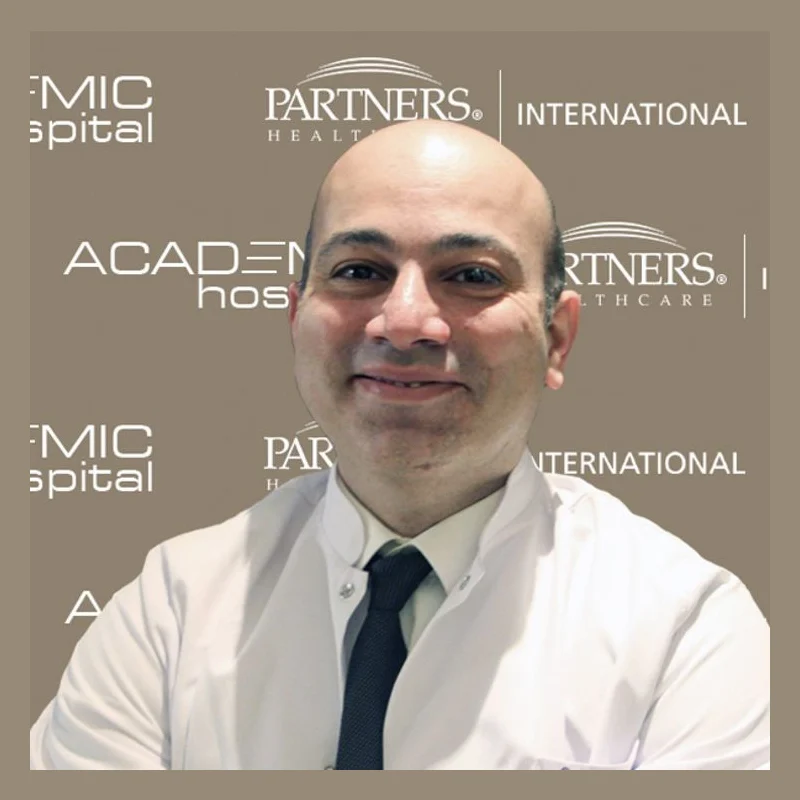
Dr. Öğr. Üyesi Görkem Kıyak
OrthopedicsVerified
- 21+years exp.
English · Turkish
FromPrice on request
Free quote
60 seconds · no obligationView Profile
What ankle arthroscopy is, how a camera and small instruments treat impingement, loose fragments and cartilage damage through two or three small cuts, when it helps and when it does not, approximate costs in Turkey against the UK, US and Germany, recovery by week, risks and how to choose an orthopaedic team.
A written plan with the surgeon's name and the full price — usually within 24 hours.

1 doctor Compare doctors, ratings and prices — ask any of them for a free quote.
OrthopedicsVerified
English · Turkish
60 seconds · no obligationView Profile
Ankle arthroscopy is keyhole surgery inside the ankle joint. The surgeon makes two or three cuts about 5 mm long at the front of the ankle, inserts a thin camera (arthroscope) and passes small instruments through the other cuts. The joint is filled with sterile fluid so that the surgeon can see the cartilage, the lining (synovium) and the ligaments on a screen. Through the same cuts the surgeon can trim inflamed tissue, shave a bony spur, remove loose fragments or treat a small area of damaged cartilage. Because the cuts are small, ankle arthroscopy usually means less pain and quicker early recovery than an open operation, and orthopaedic departments in Turkey carry it out as a day-case or one-night procedure.
This guide explains which problems it treats, what the evidence says, how it compares with other options, what it costs in Turkey against the UK, US and Germany, what recovery is like week by week and how to choose a team.
Arthroscopy is chosen when the problem sits inside the joint and a scan or examination has not explained persistent symptoms. Common reasons include:
Ankle arthroscopy is not a treatment for advanced arthritis with little joint space left; those patients are usually considered for fusion or replacement instead, see orthopaedic treatments in Turkey.
The operation is usually done under general anaesthesia, or with a spinal or nerve-block anaesthetic and sedation. A tourniquet on the thigh keeps the field clear. A traction strap or distractor may gently open the joint space so instruments fit. The surgeon inspects the whole joint, then treats the problem: shaving a spur with a small burr, removing loose pieces, smoothing damaged cartilage, or, for an osteochondral lesion, creating tiny holes in the bone (microfracture) so that repair tissue grows. The cuts are closed with a stitch or strip and the ankle is bandaged.
The operation takes roughly 30 to 90 minutes, depending on what is done. If a ligament is repaired or a larger lesion treated at the same visit, it is longer. Most people go home the same day or after one night.
For impingement, loose bodies and inflamed lining, arthroscopy has a good record of relieving pain and restoring movement, particularly in younger and active people with a clear mechanical problem. For small cartilage lesions, microfracture and related techniques help many people, though the repair tissue is not identical to normal cartilage and results can fade over time.
It works less well when the pain comes from widespread arthritis, from the tendons outside the joint or from the nerves. Quality of evidence in ankle arthroscopy is lower than for some other operations, which is why a surgeon should link your symptoms to what the MRI or CT shows, and should tell you when surgery is unlikely to help. A trustworthy clinic will not promise a pain-free ankle.
The figures below are approximate ranges for a single-ankle arthroscopy, not hospital quotes. They depend on what is done inside the joint, the anaesthetic, whether you stay overnight and what follow-up is included. Each hospital confirms its own price in a written quote.
| Country | Approximate cost range |
|---|---|
| Turkey | €2,000 – €5,500 |
| United Kingdom | €4,500 – €10,000 (private) |
| United States | €7,000 – €20,000 |
| Germany | €3,500 – €8,500 |
What changes the price: a diagnostic look versus a major repair, implants or anchors if a ligament is fixed, general versus regional anaesthesia, the night in hospital and the number of physiotherapy sessions. A package normally includes the pre-operative tests, the surgery, anaesthetist, a night if needed, crutches or a boot, medication and transfers; ask for the list in writing.
The choice depends on where the problem is and how big it is. Keyhole surgery of other joints follows the same principles; see, for example, our guide to arthroscopic meniscus repair in the knee.
| Option | Best suited to | Typical limits |
|---|---|---|
| Ankle arthroscopy | Impingement, loose bodies, synovitis, small cartilage lesions | Limited access to the back and sides of the joint; not for advanced arthritis |
| Open surgery | Large lesions, major ligament or deformity correction | Larger scar, longer recovery |
| Non-surgical treatment | First-line for most sprains and mild impingement | May not help mechanical blocking or a loose fragment |
Physiotherapy, bracing and injections are usually tried first for mild symptoms. Surgery is considered when they fail or when a scan shows a clear mechanical cause.
Good candidates have ankle pain, swelling, catching or limited movement that has not settled with several months of non-surgical care, and an examination and imaging that point to a treatable problem inside the joint. You are less likely to benefit if X-rays show severe arthritis, if the pain is mainly from tendons or nerves, if you have poor circulation or an active skin infection around the ankle, or if you smoke and cannot stop, since this slows healing. Share your MRI or CT report before travelling so that the surgeon can judge whether the operation is likely to help.
Many patients stay five to seven nights, covering the pre-operative check, surgery, the first dressing change and a review before flying. Your own surgeon sets the timetable, and it depends on whether anything was repaired or only cleaned.
| Stage | What to expect |
|---|---|
| Days 1–3 | Foot raised, ice, painkillers; crutches, partial or no weight-bearing as advised |
| Week 1–2 | Stitches out around ten to fourteen days; gentle movement exercises start |
| Weeks 2–6 | Walking without crutches for simple cases; swelling comes and goes |
| Weeks 6–12 | Strength and balance work; return to desk work earlier, sport later |
| Months 3–6 | Running and sport for most people; longer after cartilage repair |
If a bone or cartilage procedure was done, weight-bearing may be restricted for longer. Short flights are usually acceptable once the surgeon has checked the wound, with blood-clot precautions; ask about this specifically, because the ankle swells in the cabin.
There is no cosmetic before and after to compare; the change is in how the ankle feels and moves. After an impingement release many people notice that the pinching in deep flexion has gone within weeks, while swelling can last for a few months. After cartilage treatment, improvement is gradual and judged at six to twelve months. Be wary of promises of complete recovery: results depend on the diagnosis, the size of the problem, your weight, your sport and how well you follow rehabilitation. Ask the surgeon to show you the arthroscopic images and the scan findings so you understand what was treated.
Ankle arthroscopy is generally low risk, but complications occur. Reported problems include numbness or tingling near the cuts from small skin nerves, wound infection, stiffness, persistent swelling or pain, a fluid leak from a cut, and rarely injury to a tendon, a vessel or a deeper nerve. Blood clots in the leg are uncommon but possible after any foot or ankle surgery. The NHS and professional bodies such as the British Orthopaedic Foot and Ankle Society advise choosing a surgeon who does foot and ankle surgery regularly. Ask what happens if you develop a problem after returning home and who will take over your care.
Check that the surgeon is an orthopaedic specialist with regular foot and ankle experience, that the operation takes place in a licensed hospital with an anaesthetist, and that you receive a written plan and price before you pay a deposit. Red flags include a surgical recommendation without seeing your scan, promises of a guaranteed result, a quote with no breakdown, pressure to book quickly and no plan for physiotherapy. Read how our process works and request a plan through our free quote page; the hospital reviews your scans and sends a written plan and price.
Ankle arthroscopy is keyhole surgery in which a camera and small instruments are inserted through cuts about 5 mm long. The surgeon can see inside the joint and trim a bony spur, remove loose fragments or treat damaged cartilage.
It works well for impingement, loose bodies and inflamed joint lining when a scan matches the symptoms. It is less effective for advanced arthritis or pain that comes from tendons outside the joint, so the diagnosis matters.
Approximate ranges are €2,000 to €5,500 in Turkey, against about €4,500 to €10,000 privately in the UK. The price depends on what is treated inside the joint and the anaesthetic; the hospital confirms it in a written quote.
The operation typically takes 30 to 90 minutes, depending on whether the surgeon only cleans the joint or also repairs cartilage or ligaments. Most people go home the same day or the next morning.
Simple cases walk without crutches within two to six weeks and return to sport within three to six months. Cartilage repair or ligament work can extend restrictions, so follow your surgeon's rehabilitation plan.
You are asleep or numbed during surgery. Afterwards the ankle is sore and swollen for several days, which is usually controlled with simple painkillers, elevation and ice.
It is considered minor to moderate surgery because the cuts are small and the joint is not opened. It still needs an anaesthetic and a proper recovery, so it should be planned like any operation.
Arthroscopy treats mechanical problems and early damage while the joint surface is still reasonable. Replacement or fusion is for advanced arthritis. Your scans and symptoms decide, not a standard rule.
Short flights are usually allowed once the surgeon has checked the wound, often after several days. Keep the leg moving, wear compression if advised and ask about clot prevention.
Plan for about five to seven nights, covering pre-operative checks, surgery, a dressing change and a review before the flight. A larger repair may mean a longer stay.
Your request is in!
Your coordinator will contact you — usually within 2 hours, 24/7.
Want a faster, more accurate assessment?
Add photos & medical detailsLeave your number — a coordinator calls you in your language, usually within 15 minutes during office hours.
Thank you!
A coordinator will contact you at the time you chose.

