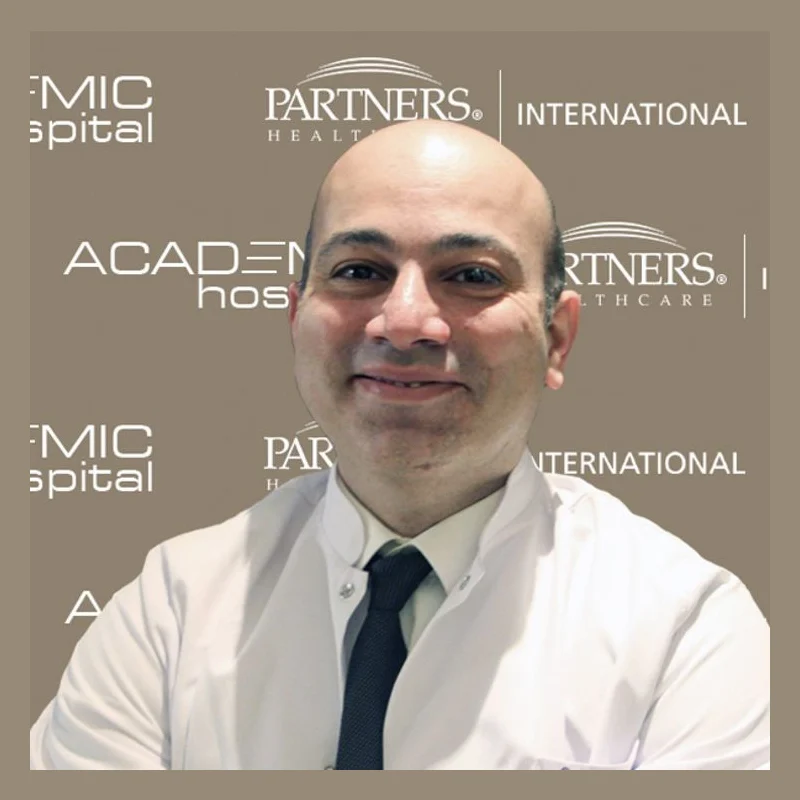
Dr. Öğr. Üyesi Görkem Kıyak
OrthopedicsVerified
- 21+years exp.
English · Turkish
FromPrice on request
Free quote
60 seconds · no obligationView Profile
What the Apifix system is, how a ratcheting rod on the curve corrects scoliosis without a full spinal fusion, which curves and ages it is meant for, what the evidence does and does not show, approximate costs in Turkey against the UK, US and Germany, hospital stay, recovery milestones, risks and questions to ask a spine team.
A written plan with the surgeon's name and the full price — usually within 24 hours.

1 doctor Compare doctors, ratings and prices — ask any of them for a free quote.
OrthopedicsVerified
English · Turkish
60 seconds · no obligationView Profile
The Apifix system is a small spinal implant for curves in adolescent idiopathic scoliosis. Apifix system implantation places a short, slender rod along the inside (concave) of the curve, held by screws in the vertebrae at the two ends of the curve only. The rod contains a ratchet that lengthens in small steps as the patient moves and grows, so the curve is corrected gradually after surgery rather than being forced straight and locked in the operating room. The idea is to keep more spinal motion than a long fusion, which joins many vertebrae. Spine centres in Turkey offer it as a planned, non-fusion alternative for suitable patients. For scoliosis surgery in general see our guide to the operative treatment of scoliosis.
It is a specialised device with a short track record, so this page sets out who it is meant for, what the evidence does and does not show, what it costs against the UK, US and Germany and how to check a spine team.
The device is intended for adolescent idiopathic scoliosis with a single main curve of moderate-to-large size, generally in the region of 40 to 60 degrees on the Cobb measurement, in patients who are close to the end of growth or have finished growing. It is not meant for very small curves that a brace may control, nor for curves with several large sections, severe stiffness, neuromuscular or congenital scoliosis, or adult degenerative curves. The exact range and age limits depend on the product approval in your country and on the surgeon's assessment, so you need full-length standing spine X-rays and bending films reviewed before anyone quotes you.
This is the honest part to read carefully. The implant has been used in small clinical studies and has been cleared for restricted use in some regions, and early reports describe meaningful correction of curves and preserved motion in most treated patients. But the numbers are small, follow-up is shorter than for spinal fusion, which has decades of data, and some patients have needed the implant to be revised or converted to a fusion. Professional spine societies, such as the Scoliosis Research Society, describe non-fusion methods as promising and still being studied. A trustworthy surgeon will explain this and will not promise a straight spine.
The ranges are approximate for the operation, implant and hospital stay, not hospital quotes. The hospital confirms its price in writing after reviewing your imaging.
| Country | Approximate cost range |
|---|---|
| Turkey | €12,000 – €30,000 |
| United Kingdom | €25,000 – €60,000 |
| United States | €60,000 – €150,000 |
| Germany | €22,000 – €55,000 |
What changes the apifix system implantation price: the cost of the implant itself, the time in the operating room, whether nerve monitoring is used, days in intensive care and on the ward, imaging, and whether the plan includes a second procedure or a convertible fusion if things do not go as hoped. A package should list surgeon, anaesthetist, implant, hospital nights, nerve monitoring, X-rays, medication and follow-up reviews. Ask what happens, and who pays, if the device needs to be revised.
| Option | Best suited to | Typical limits |
|---|---|---|
| Apifix non-fusion rod | Single moderate-to-large curve, near skeletal maturity, wish to keep motion | Limited long-term data; narrower indications; may need revision |
| Spinal fusion | Larger, stiffer or complex curves; the established standard | Fused segments lose motion; bigger operation |
| Bracing | Smaller curves in a growing child, to stop progression | Does not correct the curve; needs daily wear |
| Vertebral body tethering | Growing children with flexible curves | Uses a cord; also relatively new; some need further surgery |
Spinal fusion remains the reference operation because it has the longest record; non-fusion options are chosen after a discussion of curve size, growth stage and the family's priorities, and the team should be honest that a fusion could still be needed later.
Surgery is carried out under general anaesthesia with the patient lying on the front or side. Nerve monitoring is commonly used to protect the spinal cord. The surgeon makes an incision over the curve, places screws in the vertebrae at each end, attaches the ratcheting rod on the concave side and checks the position with X-ray. A drain may stay in for a day. Operating time is usually shorter than a long fusion, often two to three hours, though the actual time is set by the surgeon. Bone grafting across the whole curve is not required, which is how the motion is preserved. Because the device expands as the patient moves, the shape of the back changes over the weeks after surgery.
Patients usually stay three to five days. Walking begins the day after surgery, and pain is managed with medicines, as nerve and muscle soreness is common. Weeks one to two: gentle walking and rest at home. Weeks three to six: return to school or desk work, often around four weeks, with no lifting or twisting. Contact sports are often restricted for several months, and any return to sport is set by the surgeon after X-rays. Follow-up films are taken at intervals over the first year to check how the rod has lengthened and the curve has changed. Do not fly home until your surgeon has examined you; many teams ask patients to stay a week or more.
A good candidate is a young person or adult with adolescent idiopathic scoliosis, a main curve in the intended size range, a skeleton that has nearly or fully matured, and a wish to keep spinal motion, with realistic expectations. Other options may suit if the curve is outside the range, very stiff, in a growing child who could still use a brace, or associated with another condition. Bone density, general health and anaesthesia risk are also checked. For major curves that need a fusion, the team may advise it openly rather than offer the new device, and that is a sound reason to follow their advice.
Studies describe curve improvement rather than complete straightening, and results vary between patients. X-rays after surgery are the true measure, whereas photos show posture and rib hump, which change less than the curve angle. Some patients feel taller and see better balance of shoulders and waist; others see a smaller change. Ask the surgeon to show before-and-after X-rays from patients with similar curves and to state the average and the range, including those who needed another operation. Be wary of galleries that show only the best outcomes.
Every spinal operation carries risks: bleeding, infection, pain, blood clots, anaesthetic problems and, rarely, nerve or spinal cord injury. Specific to this implant are screw loosening or breakage, rod breakage or failure of the ratchet to lengthen, loss of correction and the need for a revision or conversion to fusion. In the US the Food and Drug Administration allowed the device under a Humanitarian Device Exemption, a route meant for treatments of small patient groups, which reflects how limited the data still are. Ask the surgeon for the revision rate they have seen and what follow-up they provide, including who will review your X-rays after you return home.
Look for an orthopaedic or neurosurgical spine surgeon registered in Turkey who treats scoliosis regularly, in a licensed hospital with nerve monitoring, an intensive care unit and blood bank. A good team requests full-spine X-rays before quoting. Red flags: a promise to straighten the spine fully, avoiding the topic of fusion, a quote without imaging, no named surgeon and no revision plan. Read how our process works and send your X-ray reports through the free quote page for a written plan.
It is a small, ratcheting spinal rod fixed to the vertebrae at the ends of a scoliosis curve. It lengthens as the patient moves and gradually corrects the curve without a long spinal fusion.
Mainly for adolescent idiopathic scoliosis with a single moderate-to-large curve, in patients near or at the end of growth. Smaller, very stiff or complex curves usually need a different approach.
Early studies report curve improvement and preserved motion, but the data are limited and follow-up is shorter than for fusion. Some patients need revision or fusion later, so a surgeon should explain the uncertainty.
Approximate ranges are €12,000 to €30,000 in Turkey against roughly €25,000 to €60,000 in the UK. The implant, hospital stay and monitoring affect the price, and the hospital confirms it in a written quote.
Fusion joins many vertebrae into one solid block and has decades of data. Apifix uses a short expanding rod and keeps more movement, but has less long-term evidence and narrower indications.
Most patients stay three to five days in hospital, return to school or desk work in about four weeks and avoid contact sport for several months. Your surgeon sets the timeline after X-rays.
There is pain after surgery, mostly from the muscles and the incision, and it is managed with prescribed medicines. Most patients walk the next day, and discomfort lessens over the following weeks.
Usually not completely. The aim is to reduce the curve and improve balance, and results vary. X-rays show the real change, while the appearance of the back changes less.
Beyond standard surgical risks such as infection and bleeding, there are implant-specific risks: screw or rod breakage, loss of correction and the need for revision or conversion to fusion. Nerve injury is rare.
Plan about a week or more: pre-operative checks, three to five hospital days and a review before flying. Your surgeon decides when it is safe to travel home.
Your request is in!
Your coordinator will contact you — usually within 2 hours, 24/7.
Want a faster, more accurate assessment?
Add photos & medical detailsLeave your number — a coordinator calls you in your language, usually within 15 minutes during office hours.
Thank you!
A coordinator will contact you at the time you chose.

