All-on-4 vs All-on-6: Dental Implants Compared
Compare All-on-4 and All-on-6 full-arch dental implants. Understand bone density requirements, bridge materials, recovery timelines, and costs before choosing your treatment.
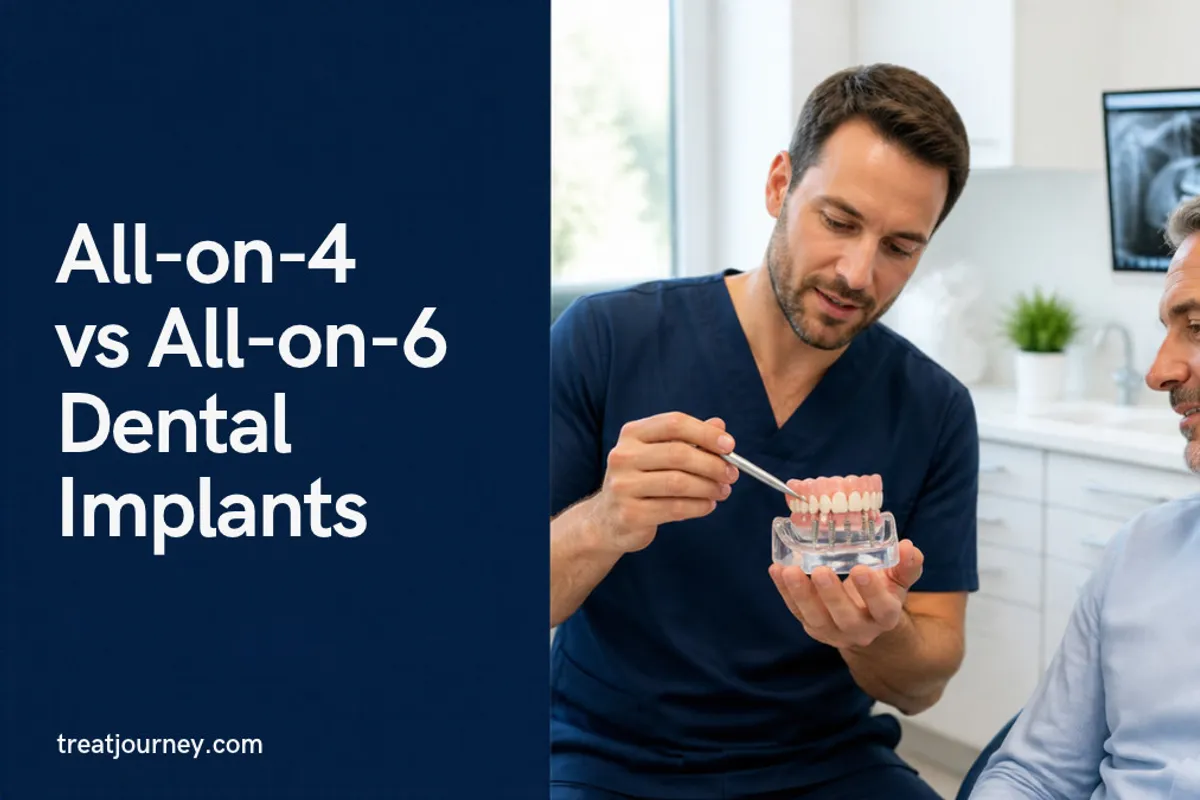
When choosing full-arch tooth replacement, comparing All-on-4 vs All-on-6 dental implants comes down to your jawbone density, bite force, and anatomical structure. Both methods replace an entire arch of missing teeth using fixed bridges anchored to titanium posts. All-on-4 angles the rear implants to maximise contact in thinner bone, whereas All-on-6 adds two additional posts to distribute biting loads across a broader foundation. Neither option is universally superior; your clinical suitability determines which approach provides dependable, long-term oral stability.
Understanding All-on-4 vs All-on-6 Dental Implants
Full-arch reconstruction replaces a full row of teeth with a prosthetic bridge anchored directly to the jaw. Rather than placing a post for every missing tooth, surgeons place strategic support points across the jaw. When you evaluate dental implants, the choice between four and six implants involves mechanical load distribution and surgical positioning.
How the All-on-4 technique works
The All-on-4 implants protocol uses four titanium fixtures per arch. Two implants are inserted vertically at the front of the jaw where bone density is naturally greater. Two posterior implants are placed at angles between 30 and 45 degrees. Angling the posterior fixtures allows the surgeon to bypass anatomical structures such as the maxillary sinus or the inferior alveolar nerve.
This angled placement increases the contact area between fixture and bone. It allows the posts to anchor into dense anterior bone, enabling patients with mild to moderate bone loss to receive fixed teeth without preliminary bone grafting.
How the All-on-6 technique works
The All-on-6 dental implants protocol places six titanium fixtures throughout the dental arch. These posts are generally inserted vertically in the front and back sections of the jaw. Spreading the foundation over six points provides greater mechanical support and load distribution.
Because six fixtures require greater bone volume across the jawline, candidates must possess adequate bone height and width. When tooth loss has caused significant bone resorption, preliminary bone augmentation is usually necessary before placing six fixtures.
Bone Density and Jaw Anatomy
Bone volume is often the decisive factor when determining how many implants for full arch rehabilitation your jaw can support. When natural teeth are lost, the alveolar ridge steadily resorbs over time due to lack of stimulation. Clinical guidelines from the Mayo Clinic highlight that sufficient bone volume is vital for fixture stability and successful osseointegration.
Upper vs lower jaw characteristics
The upper jaw (maxilla) and lower jaw (mandible) possess distinct anatomical qualities. Maxillary bone is softer and less dense, and upper molar areas sit beneath the sinus cavities. When bone in the upper jaw is depleted, All-on-4 provides a practical alternative by anchoring in denser front bone, avoiding the sinuses. In cases of severe upper jaw bone loss, zygomatic All-on-4 implants extend into the cheekbone to establish anchorage.
The lower jaw consists of dense cortical bone, providing strong initial fixture grip. In the lower arch, four implants regularly deliver sufficient stability for a full bridge. Tilting the posterior implants keeps them safely in front of the mental nerve canal, reducing the risk of nerve injury.
Bone grafting and sinus lifting
Patients opting for six implants generally need greater bone height and width throughout the posterior arch. If your diagnostic scans reveal reduced bone volume, your dental team may recommend bone grafting or sinus floor elevation. These procedures rebuild ridge dimensions using donor bone or synthetic granules protected by collagen membranes.
Undergoing bone grafting extends your overall treatment timeline. Grafts typically require three to six months to consolidate before implant fixtures can be placed. Your surgeon will evaluate your jawbone using three-dimensional cone beam computed tomography (CBCT) imaging to confirm whether grafting is needed.
Stability, Load Distribution, and Bridge Materials
Biting and chewing create continuous mechanical forces within the mouth. How these loads transfer to the underlying bone depends on fixture number, implant spread, and prosthetic material.
Biomechanical differences
An All-on-4 arrangement creates an anterior-posterior spread that supports a bridge carrying ten to twelve teeth. Because the rear fixtures are tilted backwards, the bridge has short unsupported ends known as cantilevers. However, with four posts bearing all masticatory stress, each fixture absorbs a higher concentration of force. If an individual fixture experiences failure, the entire restoration loses support and must be revised.
In contrast, an All-on-6 restoration distributes chewing loads across two additional support pillars. This spread reduces stress on individual fixtures and permits bridges of twelve to fourteen teeth. Six implants also offer clinical redundancy. If a single post fails after years of use, the remaining fixtures can often support a modified bridge. Patients with strong jaw muscles or teeth grinding often benefit from this extra structural margin.
Zirconia vs acrylic bridge options
The bridge fixed on top of your implants determines durability, oral comfort, and appearance. When evaluating zirconia vs acrylic bridge options, consider their structural properties and maintenance demands:
- Acrylic hybrid bridges use denture teeth set in acrylic over a metal framework. They are lightweight, absorb biting impact gently, and are straightforward to repair. However, acrylic resin stains more readily and wears faster over time.
- Monolithic zirconia bridges are computer-milled from solid ceramic blocks. Zirconia offers exceptional strength, natural translucency, and complete resistance to staining and chipping. Because zirconia is rigid and heavy, it transmits biting forces directly to the bone, making it well suited for sturdy six-implant foundations.
Comparison of Full-Arch Options
The following table summarises key differences between four and six implant full-arch reconstructions to help you weigh your options.
| Clinical Feature | All-on-4 Implants | All-on-6 Implants |
|---|---|---|
| Fixtures per dental arch | 4 titanium implants | 6 titanium implants |
| Posterior implant angle | Angled up to 45 degrees | Generally vertical or slight tilt |
| Bone density requirement | Low to moderate | Moderate to high |
| Likelihood of bone grafting | Low to moderate | Moderate to high |
| Masticatory load distribution | Concentrated on 4 points | Distributed across 6 points |
| Supported teeth per arch | 10 to 12 prosthetic teeth | 12 to 14 prosthetic teeth |
| Structural redundancy | Low (single failure affects arch) | High (isolated repairs often possible) |
| Upper jaw application | Well suited for reduced bone | Preferred when bone volume is ample |
| Lower jaw application | Very common and dependable | Selected for heavy bite forces |
| Recommended bridge types | Acrylic hybrid or lightweight zirconia | Monolithic zirconia or hybrid |
Both configurations offer fixed, stable alternatives to removable dentures. The choice depends entirely on your anatomical scans, bone dimensions, and functional habits.
Treatment Timeline and Trips to Turkey
Travelling for full-arch dental rehabilitation requires realistic expectations regarding treatment intervals and surgical stages. Patients investigating full mouth dental implants Turkey should understand that safe restorative care involves multiple phases to allow biological healing.
First visit and temporary teeth
Your first trip to Turkey generally spans five to seven days. During this visit, your surgical team conducts detailed CBCT scanning, records digital bite registrations, and performs clinical assessments. Any remaining failing teeth are extracted, and the implant fixtures are surgically placed.
If the fixtures achieve sufficient primary stability, your dentist will attach an immediate acrylic temporary bridge within two to five days. This temporary bridge restores chewing function for soft foods and maintains your appearance while keeping excessive load off the healing posts.
Healing and final bridge placement
Following your initial surgery, you return home for a healing period of three to six months. During this interval, osseointegration takes place as bone cells fuse with the titanium implant surfaces. Allowing this biological process to finish without disturbance is crucial for long-term fixture survival.
Your second trip requires seven to ten days in Turkey. The dental team removes the temporary bridge, inspects gum tissue around the multi-unit abutments, and captures precise digital impressions. The laboratory manufactures your permanent zirconia or hybrid bridge. Your dentist then conducts try-in fittings to check bite alignment, speech articulation, and aesthetics before tightening the bridge permanently in place.
Maintenance, Risks, and Oral Hygiene
Dental implants have high long-term success rates, yet they remain vulnerable to biological complications and mechanical wear. Information from the Oral Health Foundation underscores that implants demand thorough daily care and professional oversight just like natural teeth.
Managing biological and mechanical risks
The primary biological hazard is peri-implant disease. As noted by the American Dental Association, peri-implant mucositis is an early, reversible inflammation of the gums surrounding an implant. Without prompt intervention, it progresses to peri-implantitis, a destructive condition where chronic bacterial infection leads to bone loss and potential fixture failure.
Risk factors include poor hygiene, tobacco use, uncontrolled diabetes, and a history of periodontitis. Mechanical risks include screw loosening, acrylic tooth chipping, or ceramic fractures. Wearing a custom nightguard protects both the prosthetic teeth and underlying fixtures from nocturnal grinding forces.
Daily care checklist
Cleaning beneath a fixed bridge requires dedicated techniques to dislodge plaque along the gumline:
- Use a water flosser daily to remove trapped food debris from beneath the prosthetic bridge.
- Thread specialised bridge floss under the restoration and around each abutment post.
- Clean along the margins of each implant fixture using interdental brushes with plastic-coated wires.
- Brush all exposed bridge surfaces twice daily with a soft-bristled brush and non-abrasive toothpaste.
- Rinse daily with an alcohol-free antibacterial mouthwash to support gum health, following guidance from the NHS.
- Schedule professional cleanings and clinical assessments with a dental hygienist every six months.
Questions to Ask and Cost Transparency
Gathering clear clinical details during your initial consultations allows you to compare proposals objectively and make informed decisions.
Essential consultation questions
Ask your prospective surgical team the following questions before proceeding:
- Which implant manufacturer and model do you propose, and do you supply an official manufacturer authenticity passport?
- Does my 3D CBCT scan indicate adequate bone volume for six implants, or does an angled four-implant protocol offer a safer outcome?
- What minimum insertion torque do you require before placing an immediate temporary bridge?
- What are the specific trade-offs between acrylic and zirconia bridges for my bite pattern?
- What steps do you take if an implant fails to integrate during the initial healing interval?
- How are warranty claims and follow-up care handled once I return home?
Cost considerations and clear pricing
Treatment costs reflect the number of implants placed, the need for preparatory bone grafts, and the materials selected for restorations.
On Treat Journey, clinics display clear baseline pricing. Single implant fixtures start from €170. For complete arch replacement, an All-on-4 Turkey procedure starts from €1,880. Because six-fixture protocols involve additional surgical hardware and more frequent bone grafting, an All-on-6 Turkey plan is quoted on request based on diagnostic imaging.
Be cautious of promotional deals that conceal material specifications or compress necessary healing times. To prepare thoroughly, read our advice on dental work in Turkey: what to know and review our article on Turkey teeth to understand the differences between cosmetic crowns and reconstructive implantology.
Plan Your Treatment with Treat Journey
Treat Journey provides a transparent coordination service to help you explore hospital and clinic options in Turkey. Treat Journey does not deliver clinical treatment itself. Instead, it offers an independent platform where you can compare hospital facilities, examine doctor credentials, and read genuine patient experiences.
You can browse our directory of dental treatments to learn about available restorative procedures. When you are ready to evaluate your oral health needs, request a free quote through Treat Journey. By submitting your dental records and panoramic X-rays, you receive detailed, itemised treatment proposals directly from qualified dental teams, allowing you to choose the care plan that aligns with your clinical requirements and budget.
Send your details and a coordinator will prepare a free, written plan with verified doctors.
Hospitals offering All-on-4 Implants (per jaw) in Turkey
Frequently asked questions
The primary difference lies in the number of titanium posts placed and how chewing forces are distributed across your jaw. All-on-4 uses four implants with angled rear posts to maximise support in thinner bone, whereas All-on-6 uses six posts to provide a broader foundation for patients with sufficient bone density. Your jawbone volume and bite strength determine which option is clinically suitable.
The ideal number of implants depends on your specific jawbone dimensions, whether you are treating the upper or lower jaw, and your chewing habits. Four implants are often sufficient for the dense bone of the lower jaw, while six implants may be recommended in the softer bone of the upper jaw to distribute load evenly. A 3D CBCT scan is required to evaluate your anatomy.
Undergoing full-arch treatment abroad is safe when you select accredited hospitals and experienced dental surgeons who follow international surgical protocols. It requires careful planning, including two separate trips to allow adequate healing time between implant placement and final bridge fitting. Verifying doctor credentials and obtaining a clear treatment plan before travelling helps ensure a smooth experience.
The upper jaw naturally features softer, less dense bone than the lower jaw and sits directly below the sinus cavities. Placing six implants spreads the biting load over more points of contact, which reduces mechanical stress on any individual fixture. If sufficient bone height exists, many surgeons prefer this extra stability for upper arch reconstructions.
Full-arch implant bridges are permanently fixed to titanium posts, preventing the slippage, gum sores, and dietary restrictions common with removable dentures. Implants also stimulate the underlying jawbone, which helps slow down the progressive bone resorption that occurs after tooth loss. Patients benefit from improved chewing efficiency and natural-feeling dental aesthetics.
An acrylic hybrid bridge uses denture-grade resin teeth on a metal framework, offering slight shock absorption and easier repairs at a lower cost, though the acrylic can wear over time. A monolithic zirconia bridge is milled from solid ceramic, providing superior durability, stain resistance, and lifelike aesthetics without chipping risks. Your surgeon will recommend the most appropriate material for your bite pattern.
With diligent daily oral hygiene and regular professional cleanings, titanium implant fixtures can remain functional for decades. The attached prosthetic bridge experiences normal mechanical wear over time and may require maintenance, screw tightening, or eventual replacement after ten to fifteen years. Preventing bacterial inflammation around the gumline is essential for maximizing implant lifespan.